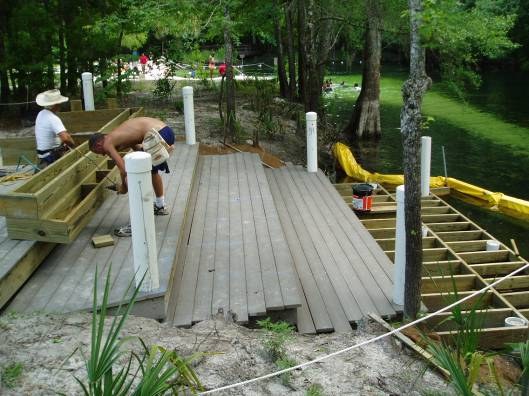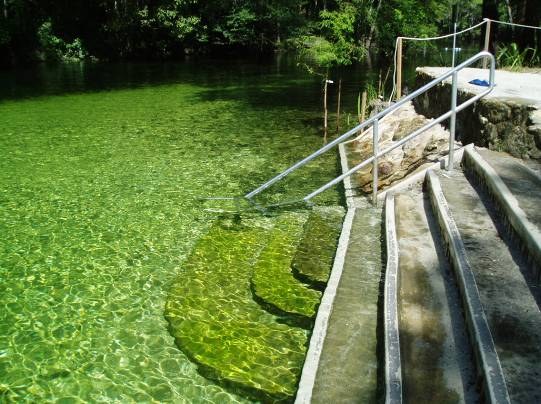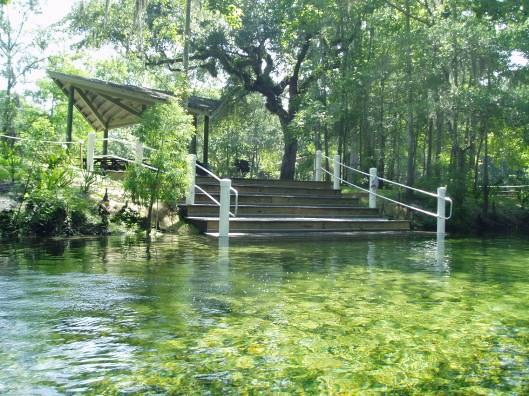
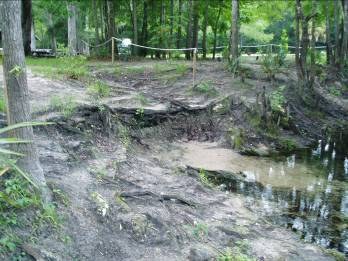
 Poe Springs Park on the Santa Fe River in Alachua County, Florida, draws heavy public use—over 26,000 visitors the prior year. A prior riparian restoration had replanted the buffer, but foot traffic still cut a shallow spring-run path into the bank. Alachua County Environmental Protection Department (ACEPD), with Florida DEP Springs funding (Agreement No. S0202), built a fan-shaped staircase to concentrate access, protect plantings, and stop further erosion into the crystal-clear spring run.
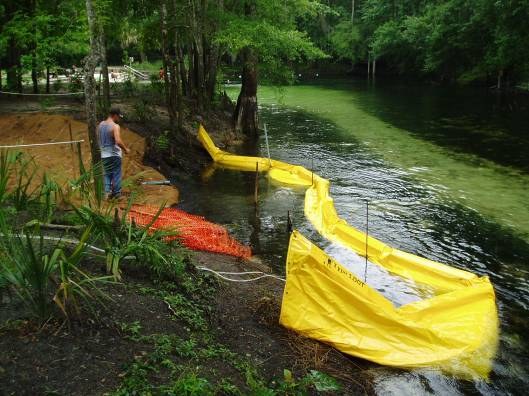 Construction in June 2005 used Filtrexx socks and jute fiber mat on the slope, a turbidity curtain in the run, PVC pilings, ACQ framing, and TREX decking. Before the curtain came out, turbid water trapped behind it measured 93.4 NTU versus 0.25 NTU in the open spring run. Crews treated the pocket with an APS Floc Log®—a soil-specific polymer that flocculates silt and clay (EPA acute toxicity tested; NSF Standard 60 listed). Turbidity fell to 32.8 NTU after the first dose and to 15.5 NTU after a second—acceptable for curtain removal.
The staircase opened in time for July 4 visitors, with two large cypress trees planted beside the run and educational tours for the Santa Fe River Springs Working Group. The Floc Log step kept colloidal sediment from re-suspending into the spring while crews finished bank work—an early Florida Springs Initiative example of polymer clarification paired with shoreline restoration BMPs. For a larger Florida job, see 27 million gallons of turbid pond water treated in Central Florida, and for another 2005 Florida restoration, soft armor on post-hurricane US Highway 98 shoulders, or browse all APS case studies.
Project: Spring-run staircase + bank stabilization; turbidity treatment before curtain removal
When: June–July 2005 (DEP Agreement No. S0202)
Partners: Alachua County EPD · FDEP Groundwater Protection · Patton Construction
Products: APS Floc Log® · Filtrexx socks · jute fiber mat · turbidity curtain
Poe Springs project gallery