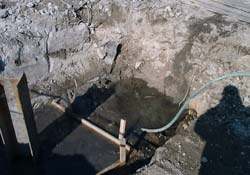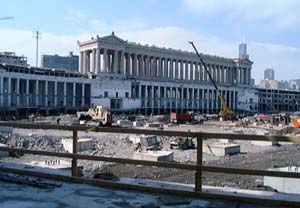
 Rehabilitation of Soldier Field began the moment the 2001–2002 Bears season ended. Demolition left the outer façade and superstructure; early March foundation work meant dewatering scores of pile-cap excavations, elevator pits, and other below-grade structures. Excavations mixed groundwater, snowmelt, rain, variable soils, concrete dust, and a black organic layer—residue from buildings lost in Chicago’s great fire—into a highly turbid “brew.” City rules required filtration through 5-micron filters before sanitary disposal; none could enter the storm drain.
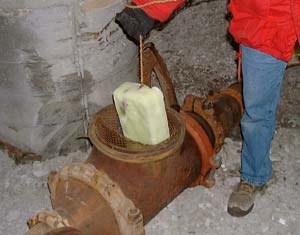
 Griffin Dewatering ran up to seven pumps (~150 gpm each, 6-inch hose) into settling tanks with nonwoven geotextile and cartridge filters ending at 5 microns. Highly turbid water clogged both stages, driving material and labor costs and failing to keep excavations dry. Overflows even reached the storm system. Through Ero-Tex (Price and Company distributor), bench tests matched APS 704b Floc Logs®—partially hydrated anionic PAM—that formed large flocs within seconds.
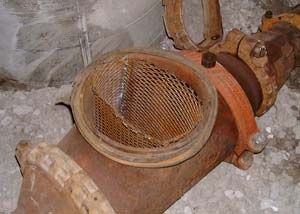
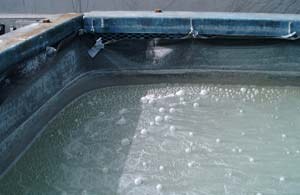
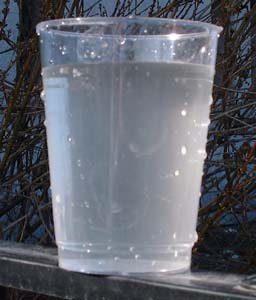
The trial placed three 12-inch tees 50–100 feet apart on one discharge line, with one or two Floc Logs in a cage inside each tee and 450+ feet of hose for mixing before a foam-sealed 40-yard dumpster. Inlet turbidity ranged 240–1300+ NTU; after settling, decant was 10–34 NTU. Advantages listed: superior performance, lower cost, passive/minimal maintenance, and easy adaptation to contractor equipment. Griffin planned to optimize the first line, convert the remaining six, and remove the clogged filter train. For a later Chicago pipe system at airport scale, see 75 million gallons clarified at the O’Hare South Basin, and for a smaller Illinois pipe setup, Floc Logs that cut detention-basin turbidity from 8,960 to 1.8 NTU, or browse all APS case studies.
Project: Dewatering clarification for pile caps, elevator pits, and below-grade work
When: Winter/Spring 2002
Partners: Griffin Dewatering · Ero-Tex (Madison, WI) · Price and Company, Inc. · APS
Products: APS 704b Floc Logs® (anionic PAM)
Soldier Field project gallery