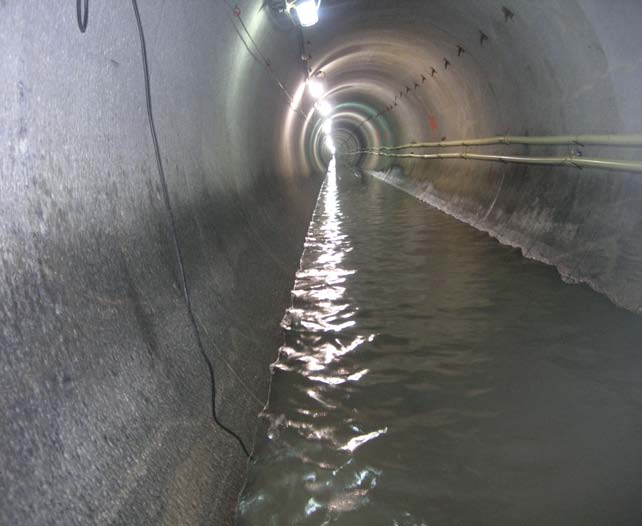
 Mole Constructors is a tunneling contractor based in Solon, Ohio. In April 2007 the company started a three-year job in Gwinnett County, Georgia: digging a 15,921-foot tunnel. Early on, the crew hit a problem. The stormwater leaving the site was turbid (cloudy with fine sediment), and it had to be clean enough to discharge offsite. That is when Mole called Applied Polymer Systems (APS).
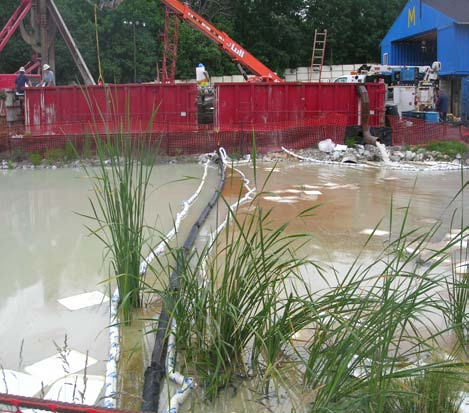
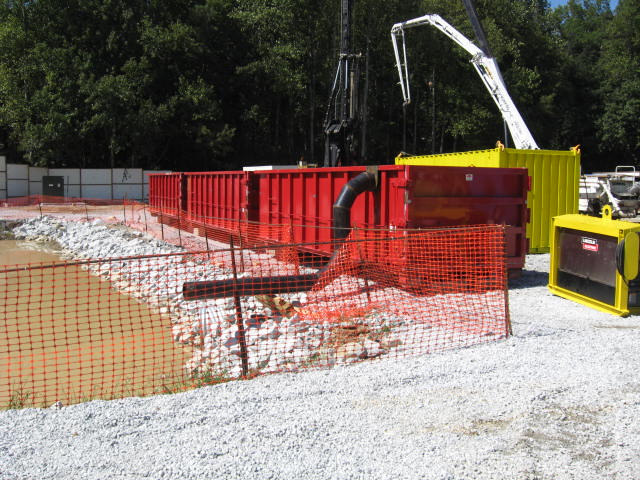
APS worked with Mole to choose Best Management Practices (BMPs) that would fix the problem. The team looked at several of APS’s performance-tested Polymer Enhanced BMPs, from a tank system with particle curtains to a split-pipe flume (see how Floc Log mixing systems are set up). Mole chose to use several BMPs together in a treatment train, because a chain of BMPs does a better job of preventing erosion and keeping discharge in compliance. The main system is three tanks with particle curtains and APS 706b Floc Logs®.
Here is how it works. Water first runs through a mixing launder, a split pipe that sits on top of the three tanks. The launder follows the tanks on three sides, then empties into the first tank. Tank 1 catches the large particles. Tanks 2 and 3 hold particle curtains, which catch the finer particles that have not settled to the bottom.
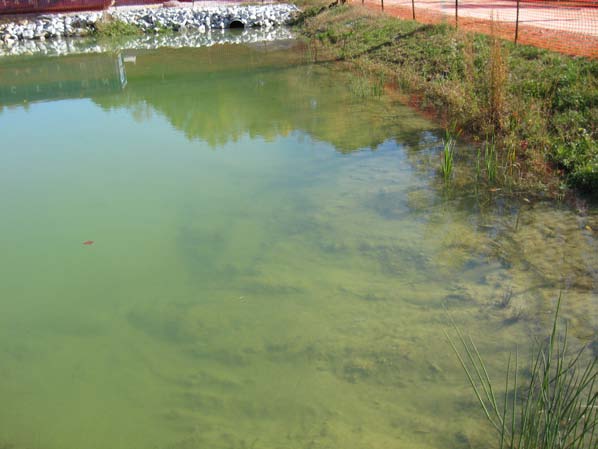
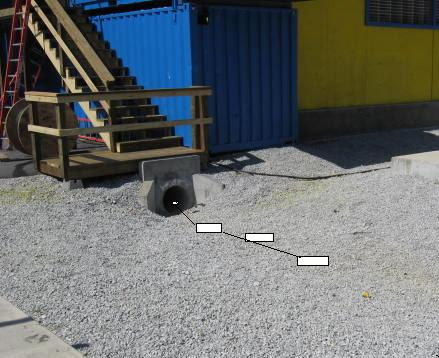 For a while, Mole also had a pH problem. The pipe between tanks 1 and 2 was retrofitted to hold a custom APS pH Floc Log. As water flowed past, the log dissolved and adjusted the pH for tanks 2 and 3. After the third tank, the water goes to a pond before it is released. As an extra step, more 706b Floc Logs sit in the pond discharge pipe and in other storm drain pipes. They clear the water further and catch any sediment it picks up after leaving the pond.
Crews checked the tanks regularly, and the readings showed turbidity coming down. In September 2008, samples were taken from each tank and from the discharge pipe. Tank 1 read 1.23 NTU, Tank 2 15.20 NTU, Tank 3 6.98 NTU, and the discharge pipe 0.62 NTU. Upstream read 1.65 NTU and downstream 1.39 NTU. That downstream number matters: Mole’s limit was no more than 25 NTU above background (the upstream reading), and downstream came in below upstream. Monitoring went on for months after that first test, with discharge and pond readings of 5.0–20.0 NTU.
Have turbid water on a dig or dewatering job? Start with a soil and water test so APS can match the right Floc Log to your site. For another Georgia project, see Floc Logs and a jute baffle grid at West Village in Atlanta; for pipe treatment on a big Chicago dig, see Soldier Field dewatering, or browse all APS case studies.
Project: Three-tank treatment system (mixing launder, particle curtains, Floc Logs) for turbid stormwater from a 15,921-foot tunnel dig
When: Three-year project starting April 2007; samples September 2008
Partners: Mole Constructors (Solon, Ohio) · APS
Products: APS 706b Floc Logs® · custom APS pH Floc Log
Mole Constructors project gallery